


- By Keith Kirkpatrick
Research Director - December 28, 2021
From a CX perspective, organizations can address personalization & optimization through a variety of approaches. These can range from using very little personalized data, such as simply capturing anonymized browsing data of all users to determine the types of products or services of interest, or by deploying a more personalized approach using zero-party data, which is information voluntarily supplied by a user in exchange for a more customized experience.
Personalization is viewed as a key element of creating deeper relationships between an organization and its customers. Recent statistics from an October survey of 15,000 global respondents published in the Salesforce State of the Connected Customer highlight the importance and value of creating a deeper level of customer engagement:
- 66% of customers expect companies to understand their unique needs and expectations.
- That same report found that 52% of customers expect offers to always be personalized—up from 49% in 2019.
- Only 27% of consumers completely understand how companies use their personal information.
These statistics highlight the challenges faced by organizations to balance the need to provide truly personalized and integrated experiences, while keeping customers apprised of how they are using that information.
While consumers appreciate the benefits of personalization & optimization, the line between personalized and creepy can be hard to ascertain. Research conducted by Periscope by McKinsey in 2019 with 2,590 consumers in the US, the UK, France, and Germany found that unsolicited communications from companies they do not know was a top issue for US consumers (41%), followed by the unsettling eeriness of location tracking messages (40%).
Additionally, receiving a follow-on message within seconds of making a purchase or completing an online search was named as the second-most-likely cause for concern by US shoppers (38%). Across each region, the survey found that women were more likely than men to feel that receiving location-based messages were intrusive and unsettling.
Fears about what is considered intrusive versus personalized can dampen enthusiasm for personalizing experiences, for fear of upsetting customers. Furthermore, if customers do feel that their experience is too personal or intrusive, the backlash can be swift, damaging the brand and potentially causing customers to flee to other competitors.
Efforts to provide more personalized experiences across the CX landscape are continuing to drive the CX software market. According to Dash Research, the market for personalization & optimization enabling software will reach $11.6 billion by 2026, increasing from $8.1 billion in 2019, and reflecting a compound annual growth rate (CAGR) of 5.2%.
Personalization & Optimization Software and Services Revenue by Region, World Markets: 2019-2026
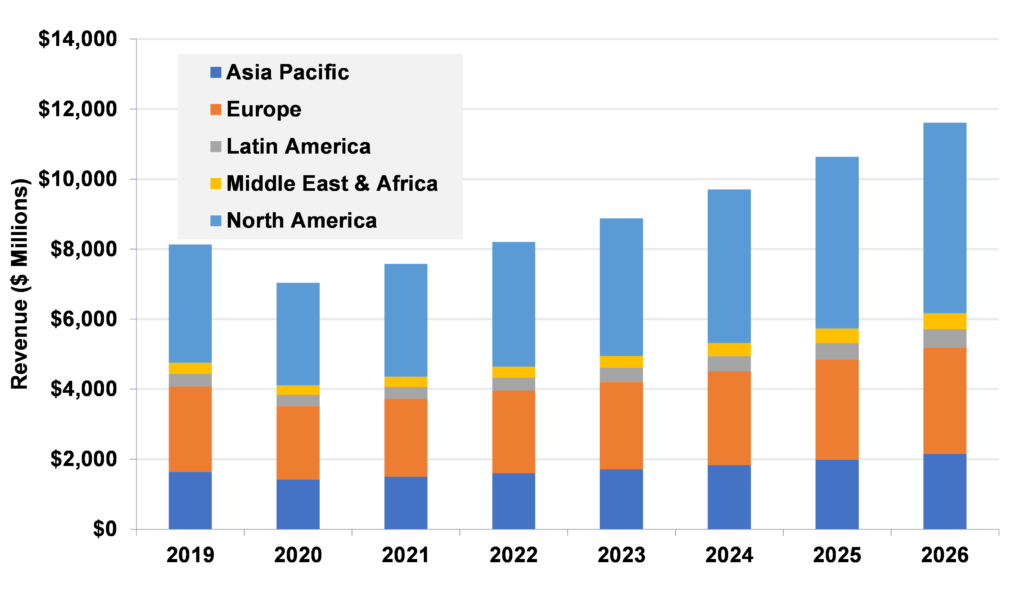
An overuse of personalization can negatively impact the CX if customers are questioning how certain personal information was captured, and whether its use feels overly intrusive or even creepy. Data security and data privacy issues also need to be evaluated and considered, along with proper disclosures on how data is used. But when used appropriately, personalization can improve customer loyalty and retention, and decrease levels of effort for both the customer and the company. Additional market drivers, barriers, and insights into the use of personalization can be found in Dash Research’s CX Personalization and Optimization report, which also contains business-to-consumer (B2C) and business-to-business (B2B) personalization case studies, as well as recommendations for deploying personalization programs that meet the needs of organizations, while retaining customers’ trust. Global market forecasts for personalization & optimization CX software are included, covering the 2019 to 2026 time period, with segmentations by geographic region, segment, product offering, and industry.

Latest Research

Employee Experience
Market Drivers and Barriers, Market Sizing and Forecasts, and Case Studies

CX in the Healthcare Industry
Patient Experience Management and Patient Engagement: Best Practices, Key Market Trends, Case Studies, and Market Forecasts

CX Market Forecasts
Customer Data & Analytics, Customer Relationship Management, Contact Center, Personalization & Optimization, Customer Data Platforms, Customer Insights & Feedback, and Employee Experience

Customer Insights & Feedback
Market Drivers and Barriers, Key Industry Players, Market Sizing and Forecasts, and Case Studies
Related Articles

Twilio’s CustomerAI Technology Enables One-to-One Customer Engagement
- By Keith Kirkpatrick June 8, 2023
The News: Customer engagement platform Twilio this week announced CustomerAI, its technology that leverages the combined power of large language models (LLMs) with the rich customer data that flows through Twilio’s Customer Engagement…
Read More
Salesforce Unveils Marketing GPT & Commerce GPT for End-to-End Personalization
- By Keith Kirkpatrick June 7, 2023
The News: Salesforce announced on June 7 at Connections its latest generative AI product offerings, Marketing GPT and Commerce GPT. The two products combine generative AI technology with trusted, real-time data from Data Cloud,…
Read More
Booking a Trip? The Digital Experience Matters
 By Sherril Hanson May 30, 2023
The News: Digital experience analytics provider Glassbox released research demonstrating how small friction points will cause customers to walk away from a brand’s digital experience and move on to a different one. According to the research,…
Read More
Personalization and Deep Understanding Need to Be at the Heart of Patient Experience
- By Sherril Hanson May 25, 2023
Dr. Adrienne Boissy, Chief Medical Officer, Qualtrics The field of experience management covers not just customer and employee experience, but other categories that are not quite the same as being labeled a “customer” or “consumer,” such…
Read More