

- By Sherril Hanson
Senior Analyst - January 4, 2022
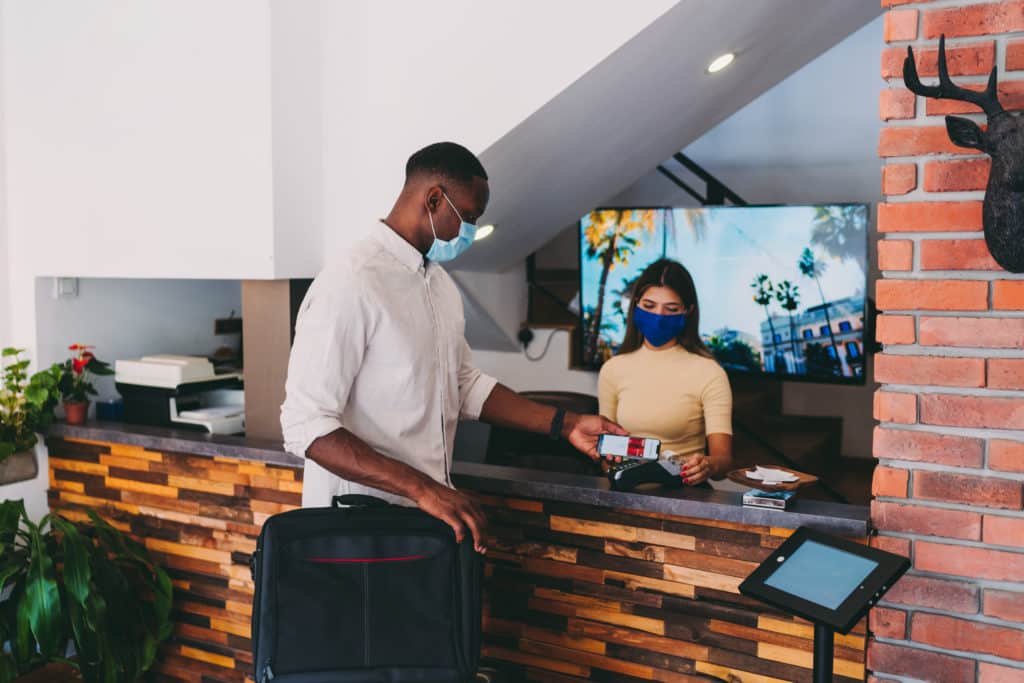
As the travel & hospitality market limps into the new year, battered by the end-of-year surge in labor shortages due to the Omicron variant of COVID-19, it is clear that contactless technologies will continue to be widely adopted as the industry seeks to limit person-to-person contact and searches for more efficiencies.
The new Dash Research report, CX in the Travel & Hospitality Industry, explores the acceleration of contactless and convenience technologies as one of the drivers in the CX market. The implementation of contactless technologies was already in the works before COVID-19, but the pandemic greatly accelerated the rollout. Contact-free hotel technologies and other convenience solutions, such as those targeted to line management and passenger tracking, have been rapidly trialed and implemented. However, the contactless movement has resulted in an explosion of other innovations being applied to the travel & hospitality market, including robots and biometrics.

Robots have been implemented in airports for a variety of reasons in the past, such as providing flight information, directions, cleaning and disinfection, or security. Since COVID-19, delivery is another option that airports are exploring. A fleet of Ottobots from Ottonomy are now available at the Cincinnati/Northern Kentucky International Airport to deliver food, beverages, and lifestyle products throughout the airport, eliminating the need to wait in line or have personal contact. Gita robots from Piaggio Fast Forward are being used for a similar purpose at the Philadelphia International Airport.
The need for fast, contactless identification across a travel journey is resulting in biometrics a lot of buzz in the travel market. Biometrics uses physical characteristics to identify individuals. This can include facial recognition, voice recognition, iris recognition, and fingerprint scanning. Trials and implementations have been launched both by government agencies and other travel-related entities. The Transportation Security Administration (TSA) is testing facial identification and the US Customs and Border Protection is investing in technologies to be used for cruise travel. Star Alliance Biometrics launched in 2020 and allows travelers to have a contactless journey throughout an airport, allowing passengers to go through each contact point from check-in to the gate using a secure identity management solution with facial recognition. This results in a reduction in physically handling paperwork and less personal contact. Biometrics is not only being used to smooth out air travel, but is also being used for train travel, with the Eurostar and iProov trial of the SmartCheck service in London’s St Pancras station serving as one example. Aside from being used to ensure ID requirements as passengers move through various checkpoints, biometrics is also being used to enable contact-free payment. An interesting implementation was recently announced by the ubiquitous travel retailer Hudson. Hudson is using Amazon’s palm recognition system (Amazon One) after travelers are through security at a certain location within the Dallas Love Field Airport. The Hudson Nonstop store will allow travelers to pay in the traditional way or hover their palm over the Amazon One device at the entrance to the store.
These contact-free ID technologies will become even more important as international travelers face requirements for increased documentation and procedures due to the pandemic, particularly when moving through customs and immigration. As travel & hospitality companies look for ways to deploy their decreased labor force in a more efficient manner and as passengers are looking for ways to more safely travel during the pandemic, these technology types will enhance a customer’s travel experience during some of the more stressful touchpoints in their journey, allowing for a more socially distanced and pleasant experience.

Latest Research

Employee Experience
Market Drivers and Barriers, Market Sizing and Forecasts, and Case Studies

CX in the Healthcare Industry
Patient Experience Management and Patient Engagement: Best Practices, Key Market Trends, Case Studies, and Market Forecasts

CX Market Forecasts
Customer Data & Analytics, Customer Relationship Management, Contact Center, Personalization & Optimization, Customer Data Platforms, Customer Insights & Feedback, and Employee Experience
Related Articles
Delta Launches, Then Pauses, Employee Recognition Program After Backlash
 By Keith Kirkpatrick June 1, 2023
The News: On May 27, news emerged about Delta Air Lines’ plan to share the first names of flight attendants with passengers in emails that will be sent to customers a day before their flight, as part of a new employee recognition tool. The tool,…
Read More
Frontier Places Last in J.D. Power 2023 North America Airline Satisfaction Survey
- By Keith Kirkpatrick May 31, 2023
The News: Frontier Airlines received a last-placing ranking in the J.D. Power 2023 North America Airline Satisfaction Survey, which saw the low-cost carrier trail rivals such as Spirit Airlines, Allegiant Air, and WestJet. The North America…
Read More
Booking a Trip? The Digital Experience Matters
- By Sherril Hanson May 30, 2023
The News: Digital experience analytics provider Glassbox released research demonstrating how small friction points will cause customers to walk away from a brand’s digital experience and move on to a different one. According to the research,…
Read More
Delta Airlines Rolling Out Personalized Digital Experience for Mobile Devices
- By Sherril Hanson May 19, 2023
The News: First announced at CES 2023, Delta Sync has started rolling out on domestic mainline flights equipped with free Wi-Fi by T-Mobile. Described as a platform that serves up personalized content, access, and offers, passengers use their…
Read More