


- By Andrew Broderick
Senior Analyst - April 7, 2022
Since 2008, the University of Utah Health (UTH) has listened to the voices of its patients. At that time, UTH laid down a challenge to its leadership to improve the patient experience with the call to action that medical care can only be great if the patient thinks it is. Five consistent themes have emerged since then as key to making a patient experience (PX) exceptional. Foremost among them are that patients want to be known, heard, and armed with a care plan that reflects that and includes their values. Also, it is important to them that their care is coordinated in an organized, efficient manner so that their needs are met. When all the elements are present, patients describe having confidence and trust in the care team, and loyalty to the health care system.
However, healthcare continues to perform poorly compared to other industries when it comes to delivering personalized experiences that healthcare consumers have come to expect, given their experiences in other industries. The 2020 Consumer Experience Index report found that healthcare consumers constantly struggle with their healthcare experiences, with almost two-thirds (62%) feeling the healthcare system feels like it is set up to be confusing. Many report that the care they receive does not treat them as humans, and that finding a provider who takes the time to understand them is challenging. Over half (53%) have the impression they are being treated as an incident, not a person, when receiving care.
AVIA, a digital transformation partner for healthcare organizations that provides market intelligence, collaborative tools, and consulting, finds that health systems are leaning into hyper-personalized care as they seek to prevent customer leakage and related revenue loss through enhancing the patient experience and increasing loyalty. By doing so, Avia has identified three building blocks in health systems’ strategies for building the data foundation that enables them to develop an “n-of-1” view of each patient, and ultimately enables them to provide proactive communications and marketing customized to individual needs.
The three building blocks are:
- Knowing the individual through understanding the consumer across disparate data points (e.g., transactional, demographic, behavioral, psychographic, care history, social determinants of health, communication preferences, decision-making patterns, perceptions about healthcare).
- Connecting with the individual by creating a consumer-facing experience that recognizes each individual on the basis of unique preferences and care needs, and activates their engagement with the health system across service functions.
- Creating personalized pathways and seamless care interactions at various touch points on the basis of understanding, anticipating, and addressing individual care needs, promoting health and wellness goals, improving health outcomes, and increasing loyalty.
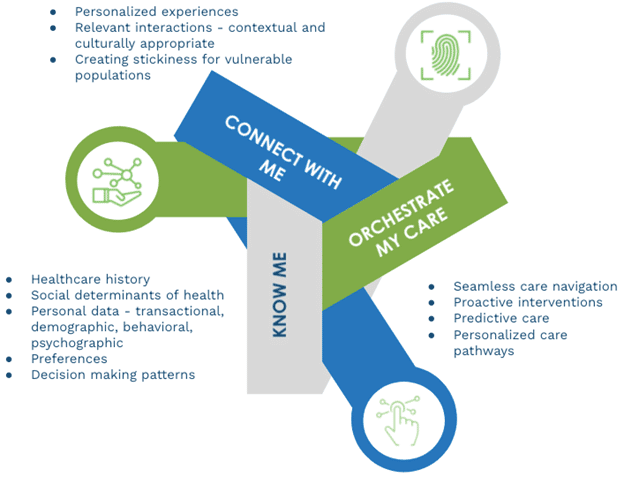
AVIA recommends that health systems implement a comprehensive, enterprise technology infrastructure if they are to effectively develop the data and communication infrastructure capabilities that would allow them to deliver hyper-personalized care. Organizations that operate at the highest level of hyper-personalized care would gain significant benefits through the potential to realize:
- 360-degree view of the consumer
- A personalized, integrated consumer app that recommends content and provides assistance with navigation
- Individually curated marketing and clinical content designed to activate patients in their care
- Personalized text, chat, and voice interactions based on personal technology preferences and behaviors
- A personal health calendar with a unified longitudinal view of patient care appointments and recommended care actions
- Self-optimizing data models and algorithms that continuously update the underlying models to provide real-time dashboards and recommendations
- Persistent navigation across modalities and settings

Latest Research

Employee Experience
Market Drivers and Barriers, Market Sizing and Forecasts, and Case Studies

CX in the Healthcare Industry
Patient Experience Management and Patient Engagement: Best Practices, Key Market Trends, Case Studies, and Market Forecasts

CX Market Forecasts
Customer Data & Analytics, Customer Relationship Management, Contact Center, Personalization & Optimization, Customer Data Platforms, Customer Insights & Feedback, and Employee Experience

Customer Insights & Feedback
Market Drivers and Barriers, Key Industry Players, Market Sizing and Forecasts, and Case Studies
Related Articles

WebMD Health Services Announces Intent to Acquire Limeade
 By Sherril Hanson June 14, 2023
The News: Wellbeing solutions provider WebMD Health Services, a part of WebMD Health Corp, announced its intention to acquire employee wellbeing company Limeade. The latter company, which is based in Bellevue, Washington, but publicly…
Read More
Personalization and Deep Understanding Need to Be at the Heart of Patient Experience
- By Sherril Hanson May 25, 2023
Dr. Adrienne Boissy, Chief Medical Officer, Qualtrics The field of experience management covers not just customer and employee experience, but other categories that are not quite the same as being labeled a “customer” or “consumer,” such…
Read More
Real-Time Engagement Builds a Better Patient Experience
- By Sherril Hanson May 22, 2023
The use of feedback technology in the healthcare sector is nothing new. Providers have been required to do follow-up surveys for years. However, the broadening view of patient experience (PX), as well as the deepening focus on healthcare employee…
Read More
The Permanente Medical Group Combines Technology and Strong Company Culture to Support Patient Experience
- By Sherril Hanson April 5, 2023
Consumers’ heightened expectations are requiring providers to be more customer centric, desiring greater convenience, better access to care, and more seamless experiences. However, healthcare organizations face a lengthy list of challenges…
Read More