


- By Keith Kirkpatrick
Research Director - September 9, 2021
A significant amount of attention in the CX community has been placed on driving excellent CX, so that customers are satisfied and feel more loyal to the organization. While increasing the number of loyal customers can help reduce some marketing and sales costs, and can generate incremental revenue, the real value with good CX is seen when loyal customers become evangelists, spreading the good word about your company, your product, or their experience to others.
While paid influencers can be useful, not all companies or industries are well suited to using this model to drive marketing or sales efforts. Moreover, paid promoters or influencers do not carry the same level of authenticity as actual customers, particularly when it comes to assessing a product’s functions, features, or reliability.
However, companies can take several steps to turn loyal customers into evangelists, who, in turn, will spread the company’s messaging and add their own authentic insights to the existing product or service value propositions.
Ultimately, customer advocacy is the highest step beyond satisfaction and loyalty, with customers feeling like they have a stake in the success of the business, largely because they believe in the product or service, and want to ensure the business will continue. Furthermore, humans like to feel an affinity with others who share similar viewpoints, interests, or experiences, and evangelism plays directly into that mindset by organically cultivating groups of people with shared interests. Customer advocates are generally highly engaged with a company, supportive of its efforts, and, at times, can be critical when the brand does not live up to expectations. However, they tend to recommend and actively promote a brand to others, through enthusiast message boards, social media, and even old-fashioned word-of-mouth recommendations. In particular, YouTube and Facebook continue to dominate the online landscape, with 81% and 69% of U.S. adults, respectively, reporting using these sites, according to February 2021 data published by the Pew Research Center.
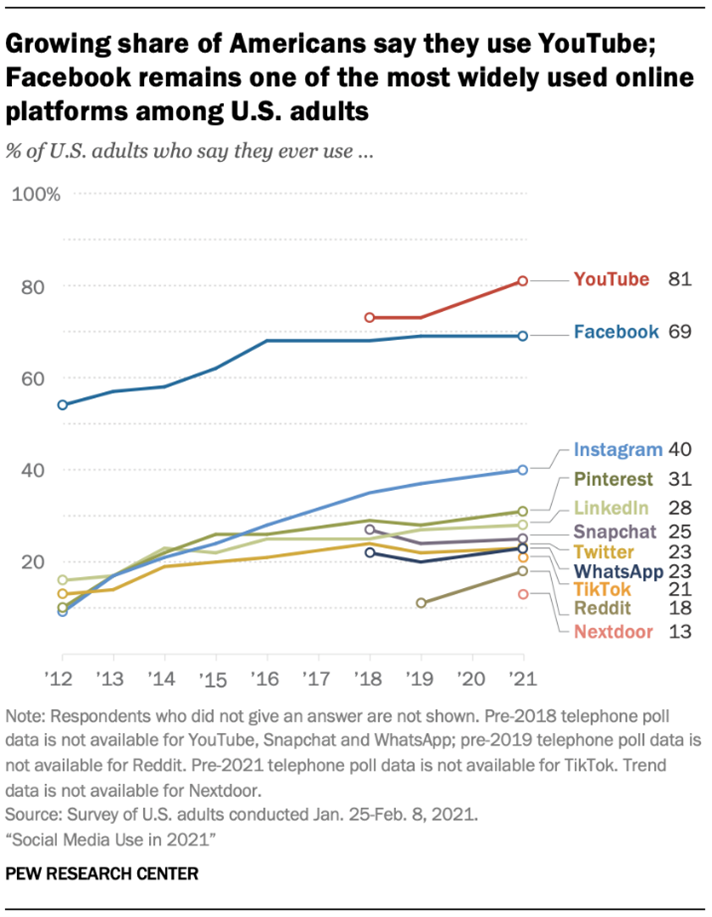
Furthermore, 7 in10 Facebook users indicate they use the site daily, including 49% who say they use the site several times per day, demonstrating the power of social media to reach and impact a wide swath of customers.

To convert loyal customers into advocates, the basic rules of providing excellent customer experiences at every touchpoint hold true. Consistently delivering great experiences will undoubtedly lead some customers to sing the company’s praises to others.
However, companies can take proactive steps to further the relationship between satisfied customers and the company. The first step is to develop a customer evangelist or ambassador program, which should be defined with objectives, activities, deliverables, and metrics in place. Company-wide buy-in will be required for success, because customer experience activity is shared across all departments.
It’s necessary to take a data-focused approach to understand who among your customers is or is likely to become a customer evangelist. One way to quickly ascertain this is by examining the customer data that is already captured, in terms of their relationship to the company. Questions such as whether they’re valuable customers now, and whether they may become even more valuable in the future are appropriate to ask. Similarly, it’s worth checking whether they actively engage with the company’s corporate sales and marketing materials, and whether they’ve interacted with PR or marketing staff.
Once created, the evangelist outreach team can identify customers that are leaving positive reviews on third-party sites, actively contributing to product or service message boards, or who are involved in discussions on social media. Identifying customers who create their own content on YouTube about a company’s product or service can be extremely valuable as evangelists, particularly if they are organically created, and are not sponsored by the company.
Further research should be conducted to identify potential evangelists’ potential circle of influence, which can be checked by verifying the number of Facebook friends or Twitter followers. By linking their social media profiles to other forums (such as personal blogs, message boards or other groups), and then reviewing their content, a clearer picture on how influential they may be.
These individuals can be invited to participate in product or service feedback sessions, as they will value being brought into the company’s “inner circle.” Furthermore, such a role will help engender an even stronger emotional connection with a brand.
That said, not all highly satisfied customers are candidates for becoming evangelists, either due to a lack of desire to fully engage with a brand, a reticence to share experiences in public forums, or because in their professional role, they are not allowed to display support for a particular product or service. In the end, developing strategies for developing evangelists and advocates can reap significant rewards, allowing the company to organically improve their connections with existing and future customers in an organic manner, without simply pouring more resources into the traditional marketing and advertising buckets.

Latest Research

Employee Experience
Market Drivers and Barriers, Market Sizing and Forecasts, and Case Studies

CX in the Healthcare Industry
Patient Experience Management and Patient Engagement: Best Practices, Key Market Trends, Case Studies, and Market Forecasts

CX Market Forecasts
Customer Data & Analytics, Customer Relationship Management, Contact Center, Personalization & Optimization, Customer Data Platforms, Customer Insights & Feedback, and Employee Experience

Customer Insights & Feedback
Market Drivers and Barriers, Key Industry Players, Market Sizing and Forecasts, and Case Studies
Related Articles

QuestionPro Acquires PathosAI
 By Sherril Hanson June 26, 2023
The News: QuestionPro, a survey and research, data, and insights services provider, has acquired PathosAI, bringing in AI expertise that will help uncover consumer intent and sentiment through measuring emotions and correlating them to why…
Read More
5 Questions with Ellen Loeshelle, Qualtrics Director of Product Management, Intelligence Platform
- By Sherril Hanson June 19, 2023
I recently spoke with Ellen Loeshelle, Director of Product Management, Intelligence Platform, at Qualtrics to hear more about how Qualtrics already has been using AI, its plans for the future, and the need to keep focused on usability. Can you…
Read More
Real-Time Engagement Builds a Better Patient Experience
- By Sherril Hanson May 22, 2023
The use of feedback technology in the healthcare sector is nothing new. Providers have been required to do follow-up surveys for years. However, the broadening view of patient experience (PX), as well as the deepening focus on healthcare employee…
Read More
The Pitfalls of Leaning into DEI Issues without Conducting Customer Research
- By Keith Kirkpatrick April 27, 2023
Diversity, equity, and inclusion (DEI) has become a major issue for both companies and the customers that purchase from them. But the backlash and boycotts against Bud Light and its parent, Anheuser-Busch, began nearly immediately after Bud Light…
Read More