


- By Keith Kirkpatrick
Research Director - August 18, 2021
Organizations of all types are increasingly investing in software tools used to manage the overall CX. Two of the key software technologies in use today have similar abbreviations, but actually serve distinct purposes, and in many organizations, complement each other to a large degree.
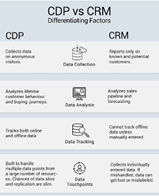
Customer relationship management (CRM) systems and customer data platforms (CDPs) are software systems that collect and manage information about customers. The primary difference between the two types of software is that CRM systems are designed to organize and manage customer interactions, while CDPs are designed to capture and collect data on customer behavior with a specific product or service.
CRM data generally will provide a customer’s name, the history of their interactions with sales, support teams, and any support tickets they may have logged with the company. Meanwhile, a CDP will track each specific step a customer has taken in their journey with the company, from the initial channel and touchpoint through any additional interactions they have had via any channel.
The key difference is that CRM systems are generally designed to help salespeople and support teams quickly locate and view each interaction the customer has had with the company, whereas CDPs are designed to help companies enhance strategies to understand how customers have been interacting with the brand, from marketing, through sales, and post-sale, all in one place. Marketers can use this data to tailor the most effective campaigns for reaching and engaging with customers, whereas engineers can assess how customers are interacting with the product or service, and then add, enhance, or delete features based on this data. Another key difference between CRMs and CDPs is how data is gathered. CRMs usually rely on manual data capture, often from notes entered by sales or support representatives, whereas data collected within CDPs is usually automatically gathered using integrations and code snippets. Customer data captured in CDPs is often generated through mobile devices, laptops, the web, or mobile apps, and then combined with customer data to help companies understand who the user is, whether they have interacted with the company before, what actions they took, and why they took them.
For most companies, it is likely that both a CRM system and a CDP will be required in order to provide the necessary visibility for salespeople, customer service personnel, product managers or engineers, and corporate strategists or C-level executives. The reason is that software with just CRM or just CDP functionality will not provide a 360° view of the customer and all their interactions with the company.
CRM systems are best for placing a laser focus on personal interactions with customers, and include historical data on those relationships, with the goal of informing future interactions. CDPs, on the other hand, are designed to consolidate and manage all customer data across all touchpoints to provide a unified view of the customer and their entire journey.
Most organizations will find value in deploying both types of software, though it is likely that organizations have more experience with CRM systems, because they have a long history as a primary sales tool. A wide variety of CDPs and CRM systems are available from vendors, and it is imperative that organizations ensure that data can be fed efficiently and easily from the CRM system to the CDP. Key must-haves from a CDP include:
- The ability to ingest data from any source
- The ability to capture full details of ingested data
- The ability to store ingested data indefinitely (subject to privacy constraints)
- The ability to create unified profiles of identified individuals
- The ability to share data with any system that needs it
Ultimately, most organizations are likely to use CRM systems as an input and output channel to a CDP, while a CDP is likely to be used to provide and support a more consistent and holistic dataset within the CRM system.

Latest Research

Employee Experience
Market Drivers and Barriers, Market Sizing and Forecasts, and Case Studies

CX in the Healthcare Industry
Patient Experience Management and Patient Engagement: Best Practices, Key Market Trends, Case Studies, and Market Forecasts

CX Market Forecasts
Customer Data & Analytics, Customer Relationship Management, Contact Center, Personalization & Optimization, Customer Data Platforms, Customer Insights & Feedback, and Employee Experience

Customer Insights & Feedback
Market Drivers and Barriers, Key Industry Players, Market Sizing and Forecasts, and Case Studies
Related Articles

Customer Care Questions Drive Significant Engagement with Social Media Platforms
- By Keith Kirkpatrick June 5, 2023
The News: Communicating with brands on social media platforms has become a preferred strategy for many consumers, according to the results of a recent Khoros survey that included more than 1,300 respondents who indicated they had tweeted…
Read More
Driving Customer Success Through an Open, Transparent Zapier Community
- By Keith Kirkpatrick May 30, 2023
The News: Zapier, a provider of automation and integration tools that allow organizations to connect to more than 5,000 applications, has focused its efforts on providing information, education, and tips to its user base through…
Read More
SugarCRM Enterprise Release Features New User Experience Improvements
- By Keith Kirkpatrick May 17, 2023
The News: SugarCRM announced in early May the addition of powerful new user experience (UX) improvements via the launch of Sugar Enterprise+, its salesforce automation platform for on-premises customers. The newest version of the Sugar…
Read More
Applying Technology to Support Better B2B Interactions
- By Keith Kirkpatrick April 5, 2023
Providing an excellent customer experience should not be exclusive to B2C companies. Indeed, while B2B companies have professional buyers, these roles are still filled by humans who have become accustomed to personalized, efficient, and on-demand…
Read More