


- By Keith Kirkpatrick
Research Director - December 29, 2021
Social media use has become pervasive, with usage cutting across a wide range of demographic segments, geographic regions, and ethnic groups. According to the Digital 2021 October Global Statshot Report published in partnership with We Are Social and Hootsuite, social media users have soared past the 4.5 billion mark globally, representing an increase of more than 400 million users between October 2020 and 2021. This total represents more than half of the world’s population total of 7.89 billion people, indicating that social media has, indeed, become a global phenomenon.
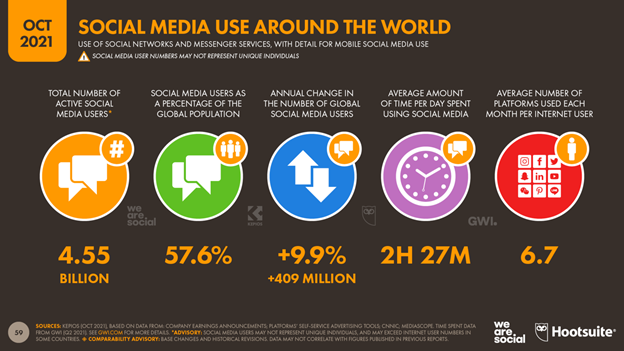
Not surprisingly, the top-five most used social media platforms continue to be Facebook, YouTube, WhatsApp, Instagram, and Facebook Messenger, each of which boasts more than 1.3 billion active users as of October 2021. That is why it is imperative that organizations develop specifical strategies and tactics for interacting with customers on the social platforms where their customers are most active.
Perhaps most important, organizations need to take an omnichannel approach to managing their social media interactions, infusing them with a consistent organizational tone and feel that reinforces social as a channel that is equivalent in importance to voice, web, or other more “traditional” channels.
First, timeliness is next to godliness, in terms of responding to inquiries, comments, criticisms, or praise on social media. The immediate nature of social media requires a timely response to communications. Unlike web forms or emails, there is less tolerance for lags in responses. Further, the viral nature of social posts means that a critical comment or post could spread like wildfire, and generate additional critical comments very quickly. Every minute or hour that goes by without a response can result in the appearance that the organization is unaware, uninterested, or unable to respond.
Organizations should use automation and artificial intelligence (AI) to address the issue of having to monitor and respond to these types of posts. Using natural language processing (NLP)/natural language understanding (NLU)-infused bots, triggers can be set up so that frequently asked questions (FAQs) are addressed immediately. Furthermore, AI algorithms can be deployed to learn from additional queries coming in, so that the automated knowledge base can be increased. Of course, this process requires human oversight to ensure that responses are correct, on-brand, and clearly presented.
Further, social responses should be phrased respectfully, without sounding argumentative or combative. Even when a comment, tweet, or criticism is unwarranted, untrue, or unfair, it is important to remain calm in all responses, as fighting back will only make the organization look petty, and could result in more negative comments from others. Instead, try to empathize with the commenter, and try to approach the interaction as an opportunity to understand why they are unhappy, or to clarify their concern. If the user has their facts wrong, it is fine to correct them, but the correction should be simply spelled out, without malice or anger.
It can also help to ask them to contact a dedicated service agent on that social platform to further discuss the problem, which demonstrates that the organization is taking the complaint seriously, and that it is willing to invest the time to address the issue directly. For example, if the complaint is made on Facebook, a suggestion should be made to contact the company on that same platform, to meet the customer where they have chosen to interact with the organization.
Maintain a consistent tone and approach across all channels. Ensuring that all communications adhere to the same style and approach conveys a sense of professionalism and consistency, ensuring that all channels are perceived as being “official.” Furthermore, maintaining a consistent approach ensures that any issues or communications that begin across social channels can be easily migrated to other channels, without creating a jarring effect for the customer.
Consistency is also important when several customers have similar complaints, across multiple communication channels. Instituting a similar response across all channels can achieve consistency of message. Consistency also helps to ensure and reinforce meeting company policies, so that each customer is treated equally, which can be exceptionally important given the ability of customers to screen grab or otherwise capture interactions between the company and other users. Additional approaches to leveraging social media will be discussed in Dash Research’s forthcoming reports focused on CX software for engagement centers and omnichannel communications, which will be published in 2Q 2022 at www.dashresearch.com.

Latest Research

Employee Experience
Market Drivers and Barriers, Market Sizing and Forecasts, and Case Studies

CX in the Healthcare Industry
Patient Experience Management and Patient Engagement: Best Practices, Key Market Trends, Case Studies, and Market Forecasts

CX Market Forecasts
Customer Data & Analytics, Customer Relationship Management, Contact Center, Personalization & Optimization, Customer Data Platforms, Customer Insights & Feedback, and Employee Experience

Customer Insights & Feedback
Market Drivers and Barriers, Key Industry Players, Market Sizing and Forecasts, and Case Studies
Related Articles

Customer Care Questions Drive Significant Engagement with Social Media Platforms
- By Keith Kirkpatrick June 5, 2023
The News: Communicating with brands on social media platforms has become a preferred strategy for many consumers, according to the results of a recent Khoros survey that included more than 1,300 respondents who indicated they had tweeted…
Read More
Driving Customer Success Through an Open, Transparent Zapier Community
- By Keith Kirkpatrick May 30, 2023
The News: Zapier, a provider of automation and integration tools that allow organizations to connect to more than 5,000 applications, has focused its efforts on providing information, education, and tips to its user base through…
Read More
SugarCRM Enterprise Release Features New User Experience Improvements
- By Keith Kirkpatrick May 17, 2023
The News: SugarCRM announced in early May the addition of powerful new user experience (UX) improvements via the launch of Sugar Enterprise+, its salesforce automation platform for on-premises customers. The newest version of the Sugar…
Read More
Applying Technology to Support Better B2B Interactions
- By Keith Kirkpatrick April 5, 2023
Providing an excellent customer experience should not be exclusive to B2C companies. Indeed, while B2B companies have professional buyers, these roles are still filled by humans who have become accustomed to personalized, efficient, and on-demand…
Read More